




This article provides a comprehensive and actionable blueprint for launching and scaling an AI Automation Agency (AIAA) from scratch to the critical $100,000 revenue mark. This process is defined by five non-negotiable milestones designed to build momentum, authority, and repeatable income.
| Milestone | Core Challenge | Strategic Solution | Example Outcome |
| 1. Skill Acquisition | Overwhelming number of tools and technologies. | Deeply specialize in a “Meta Skill” like Workflow Automation (e.g., Make.com). | A 90% proficiency in API integration and workflow orchestration. |
| 2. Client Acquisition | Zero case studies and industry experience. | Execute a small volume of Warm Outreach and offer initial services for free. | 3 testimonial-backed case studies used for marketing. |
| 3. Lead Generation | Need for a sustainable, scalable source of qualified leads. | Master LinkedIn Content using a three-pillar strategy (Expertise, Discovery, Personal). | Consistently booking 2-6 qualified calls per day organically. |
| 4. Productization | Scope creep, low close rates, and inefficient custom work. | Implement a Paid Audit and transition to a high-ticket, repeatable service Framework. | Close rate increases from 5% to 40%+ on a $9,500 offer. |
| 5. Operations | Delivery work consuming all the founder’s time. | Strategically hire and train Specialized Talent to manage the repeatable delivery framework. | Founder shifts focus from execution to sales and growth (high-leverage tasks). |
1. Skill Acquisition: Deep Specialization Over Generalism
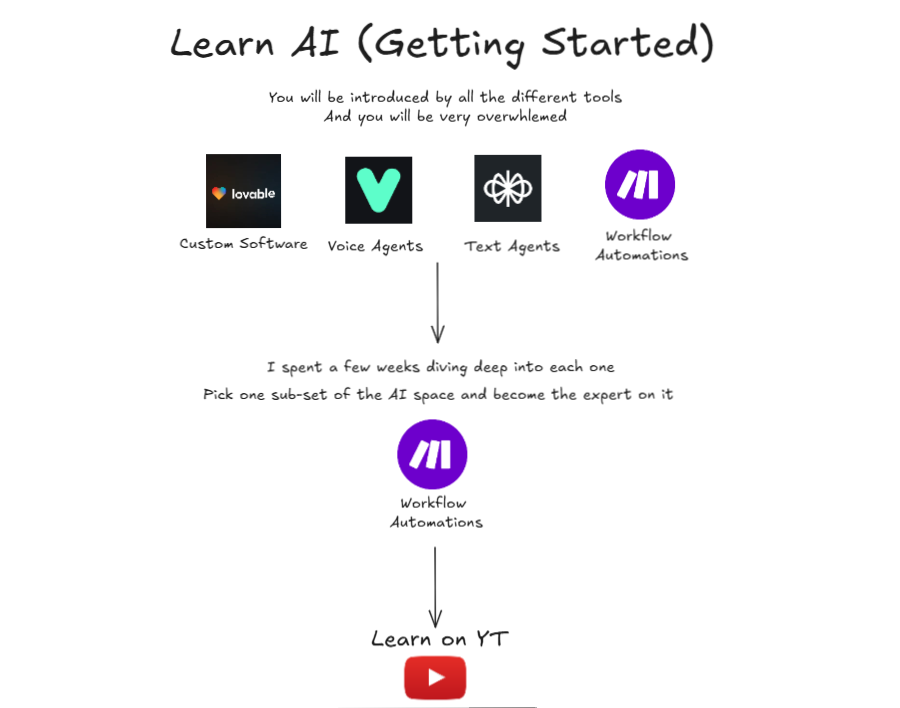
The first obstacle for any beginner is the analysis paralysis caused by the sheer volume of AI tools. The solution is aggressive, single-minded focus.
The Meta Skill Approach
- Avoid the Generalist Trap: Do not spend time trying to master Voice Agents, Custom GPTs, and Workflow Automation simultaneously. Focus is paramount for generating early results.
- The Recommended Focus: Commit to Workflow Automation using a no-code/low-code platform like Make.com (formerly Integromat). This is a “meta skill” because it teaches the underlying principles of modern software:
- APIs (Application Programming Interfaces): Understanding how different apps communicate with one another.
- Webhooks: How apps instantly notify each other when an event occurs (e.g., a new lead in a CRM).
- Data Structure: How to map and transform data between disparate systems (e.g., from a Google Sheet to HubSpot).
- Learning Strategy: Treat the process as documentation. Leverage YouTube for free tutorials and build simple personal projects. Example: Automate your personal lead tracking system, connecting your email to a Google Sheet and triggering a Slack notification.
2. Client Acquisition: Building Momentum with Unscalable Work
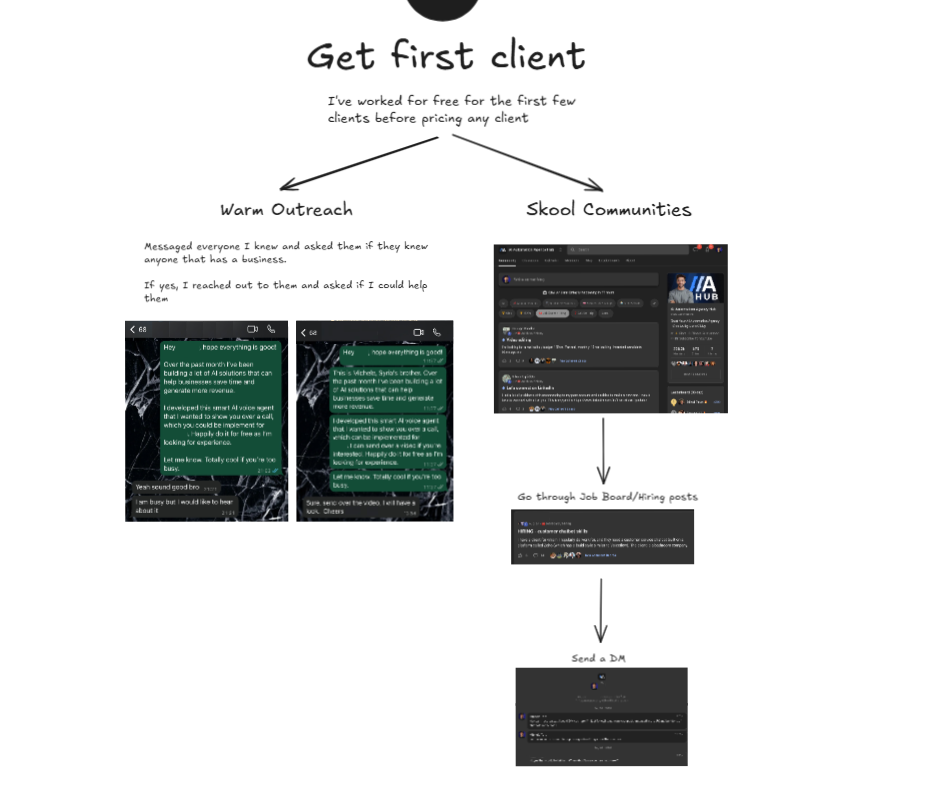
Lacking a portfolio is the main barrier to charging high prices. The solution is to do the “unscalable” work of offering services for free or very low cost in exchange for experience and testimonials.
The Warm Outreach Strategy (The Fastest Path)
This method is the quickest route to the first client because it relies on existing trust.
- Network Mapping: Systematically list all contacts. Go beyond immediate connections to second-degree connections (e.g., a friend’s boss, your cousin’s contact). Do not self-reject based on age or perceived lack of network.
- The Low-Friction Ask: Send a simple, non-salesy message.
- Example Script: “Hey [Contact Name], I’ve just started an agency building small automation systems to save businesses time and money. Do you happen to know anyone in your network who might be interested in a quick, free audit of their processes?”
- Community Job Boards: Actively monitor “hiring” or “job post” channels in specialized business communities. These are high-intent leads that are actively seeking help.
The Critical Delivery Fix
- The Initial Problem: Many early projects fail when the client is asked to set up technical integrations (like granting API keys or connecting accounts). This leads to confusion and often, ghosting.
- The Solution: When a deal closes, schedule a live “Setup Call.” Guide the client through sharing their screen and connecting the systems (e.g., “Share your screen, click ‘Add new connection’ in Make, log in to your CRM, and grant access”). This eliminates friction, guarantees you access, and professionalizes the initial client experience.
3. Lead Generation: Mastering the One-to-Many Engine
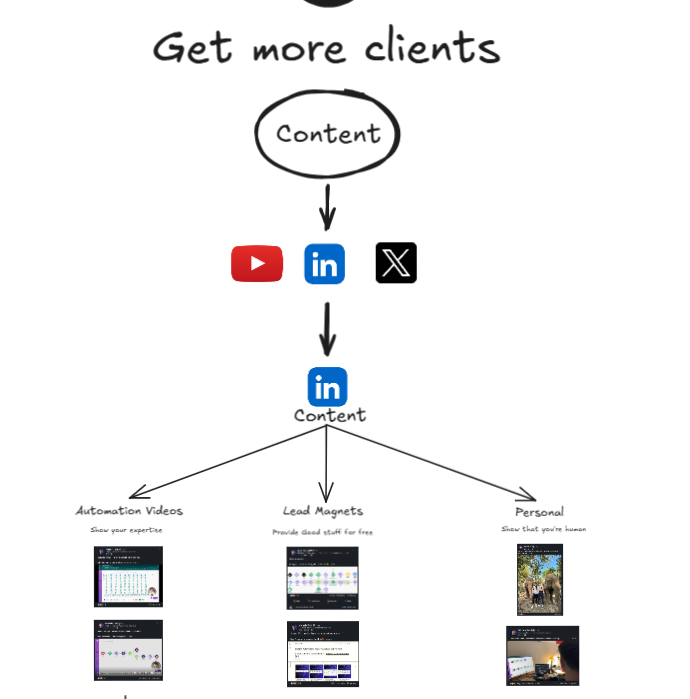
Once a portfolio is established, you must transition from one-to-one outreach to a scalable one-to-many content strategy to generate leads organically.
Dominate a Single Platform (e.g., LinkedIn)
Commit all your content energy to one platform (like LinkedIn, where business owners spend their time) until you achieve consistent, predictable results.
The Three-Pillar Content Strategy (The Organic Lead Formula)
| Pillar | Goal | Content Type & Execution | Example Post Hook |
| 1. Expertise (Credibility) | Showcase technical capability and domain authority. | Automation Videos: Short, engaging screen recordings of complex workflows. | “Watch this crazy 7-step Make.com workflow automate 80% of client onboarding. It takes 5 seconds.” |
| 2. Discovery (Algorithm) | Leverage the algorithm for maximum reach and lead capture. | Lead Magnets: Posts offering a free, valuable asset (e.g., a 5-page guide). Ask users to comment a keyword. | “I built the ’30-Day Agency Automation Guide.’ Comment ‘GUIDE’ and I’ll DM you the link.” (Each comment pushes to that user’s network.) |
| 3. Personal (Trust/Brand) | Build a relatable human brand separate from generic service providers. | Personal Stories/Grind: Share setbacks, lessons, and the reality of building the agency. | “I just spent 72 hours trying to fix one webhook error. It’s a grind, but the win was worth it. Behind-the-scenes look…” |
The Optimized Post Structure
Content must be scannable for busy executives:
- The Hook: Mobile-Optimized (40 Characters): Summarize the outcome with a number (e.g., “4 Steps to Increase X”) to immediately hook the reader.
- The Body: Avoid massive text blocks. Use short, single-sentence paragraphs and bulleted/numbered lists with formatting (emojis, arrows) to guide the reader through the value proposition.
- The CTA (Call-to-Action): Clearly instruct the reader on the next step (e.g., “Check the link in the comments” or “DM me to chat about your workflows”).
4. Productization: Scaling with High-Value Offers
The stress of low conversion, custom work, and scope creep is solved by standardizing your service and adding financial friction to the sales process.
Niche Down to a Repeatable Framework
- Analytical Niche Selection: Review the last 10-20 clients and identify the overlap: What common problem brings in the most revenue and aligns with your capabilities?
- Define a Specific Productized Offer: Transition from hourly custom work to a fixed-scope, fixed-price Framework targeted at a specific niche.
- Example Niche & Goal: Target Digital Marketing Agencies with the goal: “Double client delivery capacity without hiring more people.”
- The Framework: Create a multi-step delivery process (e.g., The AIAT Framework:

This allows you to sell a predictable, high-value product (e.g., priced at $9,500).
Implementing the Paid Audit/Exploration Milestone
This strategic addition dramatically improves the close rate by filtering leads early.
- The New Sales Funnel:
- Phase 1 (Free): Short, 20-minute Diagnostic Call.
- Phase 2 (Paid): Pitch a Paid Audit (e.g., $200 – $800) for a 1-2 hour deep dive.
- Financial Qualification: If a lead is unwilling to invest a small amount to explore a solution to their problem, they are unlikely to buy the full $9,500 service.
- Value Creation: The paid audit guarantees that your time is respected, and the deep analysis generates the exact pain points and metrics needed to make your full proposal a necessary next step. This is responsible for boosting close rates from 5% to 40%.
5. Operations: Outsourcing and Scaling Delivery
To break the revenue ceiling, the founder must transition from an executor to a strategist. Delivery work must be delegated to focus on high-leverage activities (sales, content, strategy).
Strategic Hiring and Talent Management
- Avoid the “Cheap Generalist” Trap: Hiring low-cost, low-quality freelancers (often found on global marketplaces) requires excessive training and project oversight, consuming more time than doing the work yourself.
- Hire Specialists: Hire people who are experts in the specific tools within your productized framework.
- Example: Hire a Notion Specialist to handle the project management system setup, and a dedicated Make.com Developer to handle the automation module.
- Cultivate Long-Term Commitment:
- Set Clear Expectations: Define quality standards and deadlines from day one.
- Paint a Vision: Treat contractors as valuable partners. Share the agency’s growth vision and show them how their role can expand in the future. This builds loyalty and commitment, ensuring they prioritize your projects.
Focused
🔥 Ready to skip the struggle and implement the full playbook?
Click the link below to get the entire, detailed blueprint showing the 5-step process to build your $100K AI Automation Agency.
👉 businessleaders.ai/the-0-to-100k-ai-agency-master-plan-a-detailed-blueprint/





Leave a Reply