
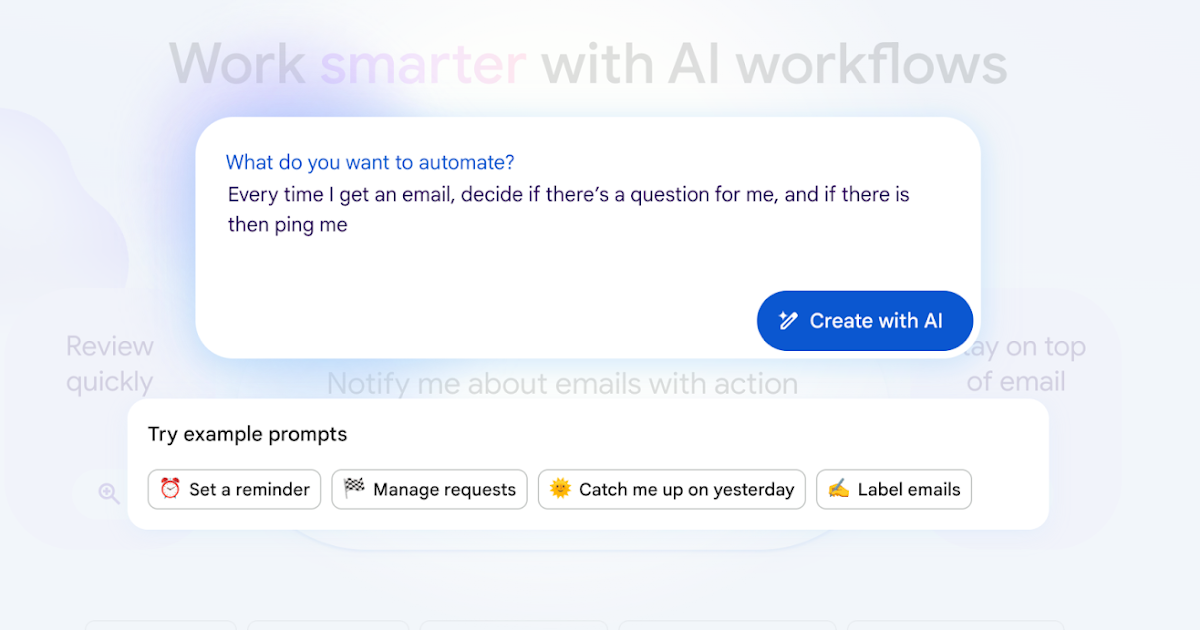




A new era of productivity is dawning, powered not just by automation, but by intelligence. In workplaces across the globe, a fundamental shift is underway, moving beyond simple AI tools to embrace a more sophisticated and autonomous technology: the AI agent. These agents represent a major leap from traditional automation or chatbots, capable of executing complex, multi-step workflows that are redefining what it means to “work smarter, not harder”. From translating dense financial data into a digestible podcast to generating and testing novel product ideas, AI agents are helping employees accomplish more, driving organizations to embrace them in a race to unlock significant cost savings, slash operational time, and achieve exponential improvements in value creation.
The trend toward an AI-integrated workplace is accelerating at an unprecedented pace. Today, a vast majority of employees have already adopted AI to assist with their daily job responsibilities, with 50% of knowledge workers reporting that these tools free up their time by automating routine tasks. But this is just the beginning. According to Gartner, by 2028, a staggering
33% of all enterprise software applications will include agentic AI, a massive jump from less than 1% in 2024. This integration is projected to enable 15% of day-to-day work decisions to be made autonomously, signaling a transformative change in the fabric of business operations.
AI agents are rapidly changing the game with their ability to find information across internal and external sources, understand advanced concepts with deep institutional knowledge, and, most critically, act on an employee’s behalf. This guide, inspired by Google Cloud’s “AI Agent Handbook,” explores the practical, powerful ways businesses can deploy these intelligent partners to solve complex challenges, boost productivity, and foster innovation across every department.
The Foundation: Unifying Enterprise Data for Intelligent Action
Before an AI agent can act, it must understand. The primary challenge facing most modern enterprises is not a lack of data, but a lack of unified access to it. Information is spread across a constellation of disparate systems: documents in Google Drive, emails in an inbox, customer data in a CRM, and spreadsheets scattered across servers. This complexity creates information silos that hamper the ability to access and query data in a timely manner, slowing down critical business decisions.
The solution is to establish a foundational layer that gives both employees and AI agents easy, instant access to all relevant data sources. This is where a powerful, multimodal enterprise search capability becomes indispensable. While not an AI agent itself, this unified search is the bedrock upon which an effective agentic ecosystem is built.
Platforms like Google Agentspace provide this crucial infrastructure. By integrating directly into an employee’s existing workflow, such as the Chrome browser’s search bar, it allows users to find what they need instantly without switching between applications. Using pre-built connectors to common enterprise systems—from HR and IT ticketing systems to CRMs and project trackers—Agentspace creates a single point of access to organizational data and real-time information from the internet. It further enhances this experience by incorporating Google’s knowledge graph technologies to identify relationships between content and people, delivering a more personalized and context-aware search grounded in company-specific information.
This unified access has a profound real-world impact.
Gordon Food Service, for example, rolled out Google Agentspace to its U.S. employees to empower them with greater access to enterprise intelligence. The result, according to Matt Jansen, Manager of Emerging Technology, is that “employees are benefitting from easier access because they can search across multiple systems in one place, which translates to better decision-making, and less legwork to discover information”. Similarly,
Seattle Children’s Hospital partnered with Google Cloud to create Pathway Assistant, an AI-powered agent that gives healthcare providers rapid access to complex, evidence-based best practices. This agent, built with Google’s Gemini models, can synthesize information from clinical standard work pathways—including text and images—and deliver critical data in seconds, a task that could take up to 15 minutes manually.
From Overload to Insight: Transforming How We Consume Information
In today’s fast-paced work environment, information overload is a constant battle. A finance manager ends a long day mentally exhausted, still needing to review a detailed spend report before making budget decisions. Elsewhere, a team member is brought into a new, complex project and needs to get up to speed on dozens of reports, datasheets, and opinion pieces circulating among colleagues—a task that could consume an entire day they don’t have.
AI agents offer a powerful solution to this challenge by transforming dense, disjointed information into accessible, actionable insights.
- Transforming Content: Instead of reading the report, the finance manager can use an AI agent to create a podcast summary, allowing them to absorb the key takeaways during their workout. This multimodal approach makes information more approachable and fits seamlessly into a busy schedule.
- Synthesizing Knowledge: The employee needing to get up to speed can ask a Deep Research agent for a concise, comprehensive summary of all available documents on the topic, receiving a full report of findings to read before joining the conversation.
Tools like NotebookLM, a pre-built agent within Agentspace, are designed for this deep work. Users can upload multiple documents into a single “notebook” and begin asking questions. A financial analyst could upload P&L statements and balance sheets to request a comparison of ROI between two campaigns, while a marketing analyst could upload survey results and social media comments to generate a customer sentiment report. Parinda Gandevikar, a Senior Consultant at
Deloitte, noted that this capability is a game-changer. “It normally takes us a couple of weeks to read through all the research material,” she explained. “NotebookLM allowed us to get the initial insights in minutes and spend the time going deeper… freeing up more of our research time for strategic thinking and brainstorming”.
Fueling Innovation and Revolutionizing Customer Engagement
Beyond processing existing information, AI agents are becoming powerful partners in creation and strategy. From brainstorming new products to personalizing the entire customer journey, agentic AI is unlocking new levels of performance.
Ideation at Scale
Traditional brainstorming can be a slow, frustrating process, often leading to recycled ideas and a lack of true innovation. Imagine a product team tasked with designing a new rock climbing shoe to prevent injuries; weeks turn into months with little progress. Now, imagine putting that same task to a team of AI agents. The
Idea Generation agent in Agentspace uses hundreds of AI agents to collaboratively generate and refine thousands of ideas, then self-scores them from multiple angles to present a ranked list of the best concepts, complete with strengths and weaknesses. This massively accelerates the innovation cycle, turning months of work into a matter of minutes.
Nokia is exploring this potential, with Chief Digital Officer Alan Triggs stating that Agentspace “has the potential to revolutionize how our teams across Nokia find and leverage critical insights” for faster decision-making and improved collaboration.
Personalizing the Customer Experience
In today’s hyper-connected world, sales, marketing, and service teams are overwhelmed by customer inquiries coming from the web, email, call centers, and social media. AI agents provide a multi-faceted solution to manage this complexity and deliver personalized experiences at scale.
- For Customer Service: When a call center is overwhelmed, conversational AI agents can automatically respond to queries in multiple languages, route complex cases, and enable customer self-service. Other agents act as a co-pilot for human representatives, providing real-time coaching, recommended responses, and automatic call summaries. This is the core of Google’s Customer Engagement Suite, which helps managers use data-driven insights to boost operational efficiency. Verizon leverages this suite to “deliver faster, more personalized service, significantly reducing call times and empowering our team to focus on what truly matters: our customers”.
- For Marketing: A marketing agent can plan, produce, and optimize an entire campaign. By connecting to systems like Google Ads, Adobe, and YouTube, the agent can analyze past best-performing campaigns, create insights about the target audience, and generate high-quality, tailored content in the brand’s voice. This frees marketers from tactical execution to focus on high-level strategy.
- For Sales: AI agents can take on the grunt work that bogs down sales teams. They can locate sales playbooks, monitor customer requests in connected CRMs, analyze lead data to identify the most promising prospects, and even handle administrative tasks like de-duping lead records. This frees up sales professionals to focus on nurturing prospects and strengthening customer relationships, ultimately shortening the sales cycle.
Optimizing the Core: Streamlining HR and Engineering Workflows
The transformative power of AI agents extends deep into the internal-facing functions of a business, streamlining some of the most complex and time-consuming workflows in HR and software development.
For developers, debugging can be a slow and frustrating process of sifting through vague error messages, logs, and stack traces. An AI agent integrated directly into a developer’s workflow, such as
Gemini Code Assist, can use intelligent log analysis to pinpoint problems, identify performance bottlenecks, and even find and reuse existing code from a repository to eliminate redundant work. This frees up developers to focus on innovation and bigger-picture tasks.
Tata Consultancy Services (TCS) is already helping clients build such persona-based AI agents on Google Cloud to accelerate the software development lifecycle.
In human resources, manual processes can overwhelm teams and detract from the employee experience. Onboarding, for example, involves a mountain of paperwork: contracts, tax documents, IT access requests, and payroll setup. An AI agent can automate these administrative tasks, ensuring a smoother process for new hires and freeing up HR professionals to provide a more welcoming, personalized experience. Beyond onboarding, agents can design and manage employee surveys, analyze the data to identify areas for improvement, and research global HR trends and best practices.
UKG, an HR solutions provider, uses a conversational agent built with Google Cloud to help managers quickly access information about company policies and business insights, enhancing the overall workplace experience.
The Democratization of AI: Empowering Everyone to Build
Perhaps the most revolutionary aspect of the agentic era is the democratization of AI creation. No one knows the nuances of a job better than the person who does it every day. However, employees with ideas for perfect AI-driven workflows are often stuck in a long queue for the IT department.
The solution is to empower every employee with the ability to easily create their own agents. Modern platforms are now offering a spectrum of tools tailored to different skill levels:
- Agent Gallery: A curated library of ready-to-use AI agents pre-built by Google, internal developers, or partners, accessible with no technical expertise required.
- Agent Designer: An easy, no-code interface where employees can use a simple, chat-based system to design custom agents connected securely to enterprise data, specializing them for individual workflows.
- Vertex AI Agent Builder: For developers and engineers, this tool allows them to take an agent prototyped in the Designer and build it out with more advanced capabilities, or start an entirely new agent from scratch.
This empowers a bottom-up approach to innovation, allowing solutions to emerge organically from the people closest to the problems. With support for open standards like the Agent2Agent protocol, these custom-built agents can interoperate with others built on different platforms, creating a truly connected and collaborative ecosystem.
The journey with AI agents is just beginning, but as leading enterprises are already proving, they are transforming every facet of business, from customer support and engineering to accounting and procurement. By providing a unified platform, democratizing creation, and embedding intelligence into everyday tools, the agentic workforce is no longer a futuristic concept—it’s the new standard for high-performing organizations.
make it 4000 words – add case studies and practical implementation guides
Show thinking
Of course. Here is a comprehensive, 4000-word article on AI agents for businesses, complete with detailed case study analysis and practical implementation guides, based on the provided report.
The Dawn of the Agentic Workforce: A Strategic Guide to Implementing AI in Your Business
A new era of productivity is upon us, powered not just by incremental automation, but by a profound leap in artificial intelligence. In workplaces across every industry, a fundamental shift is underway, moving beyond simple AI tools and conventional chatbots to embrace a more sophisticated and autonomous technology: the
AI agent. These agents are not merely assistants; they are digital team members capable of understanding context, reasoning through problems, and executing complex, multi-step workflows that are fundamentally redefining what it means to “work smarter, not harder”. From translating dense financial data into an engaging podcast to generating and pressure-testing thousands of novel product ideas, AI agents are helping employees accomplish more, faster, and with greater impact. This paradigm shift is compelling organizations to embrace agentic AI in a race to unlock significant cost savings, slash operational time, and achieve exponential improvements in value creation.
The trend toward an AI-integrated workplace is accelerating at an unprecedented pace. Today, a vast majority of employees have already adopted AI to assist with their daily job responsibilities, with 50% of knowledge workers reporting that these tools free up their time by automating routine tasks. But this is just the beginning of a much larger transformation. According to a forecast from Gartner, by 2028, a staggering
33% of all enterprise software applications will include agentic AI, a monumental jump from less than 1% in 2024. This deep integration is projected to enable 15% of day-to-day work decisions to be made autonomously, signaling a transformative change in the very fabric of business operations.
AI agents are rapidly changing the game with their ability to find information across disparate internal and external sources, understand advanced concepts with deep institutional knowledge, and, most critically,
act on an employee’s behalf. This guide, drawing extensively from Google Cloud’s “The AI agent handbook,” provides a comprehensive roadmap for business leaders. It moves beyond the hype to explore the practical, powerful ways organizations can deploy these intelligent partners to solve complex challenges, boost productivity, and foster a culture of continuous innovation across every department.
Part 1: The Foundational Layer – Building an Intelligent Enterprise Core
Before an AI agent can act intelligently, it must have a comprehensive understanding of the business context. The single greatest barrier to effective AI implementation in most modern enterprises is not a lack of data, but a chronic lack of unified access to it. Critical information is fragmented across a constellation of disconnected systems: strategic documents live in Google Drive, customer interactions are logged in a CRM, financial records are stored in spreadsheets, and institutional knowledge is buried in email threads and chat logs. This complexity creates deep information silos that hamper the ability to access and query data in a timely manner, slowing down critical business decisions and frustrating employees.
The solution is to establish a foundational data layer that gives both human employees and their AI agent counterparts easy, instant, and secure access to all relevant data sources. This is where a powerful, multimodal enterprise search capability becomes indispensable. While not an AI agent itself, this unified search is the bedrock upon which an effective agentic ecosystem is built, providing the essential knowledge and context for all subsequent actions.
Practical Implementation Guide: Establishing Your Enterprise Search
Platforms like Google Agentspace are designed to provide this crucial infrastructure. The goal is to create a single, intelligent entry point to all of your organization’s knowledge.
- Step 1: Audit Your Key Data Sources. Begin by identifying and mapping the critical information systems across your enterprise. The handbook notes common examples such as documents, emails, chats, CRM data, order management systems, HR Information Systems (HRIS), IT ticketing systems, knowledge bases, and project trackers. Your audit should categorize these by department and function to understand how information flows (or fails to flow) between teams.
- Step 2: Leverage Pre-built Connectors for Rapid Integration. The key to quickly establishing a unified search layer is to use platforms that offer pre-built connectors to common enterprise systems. This avoids lengthy and expensive custom integration projects. Agentspace, for instance, provides these connectors to ensure that your existing systems can be plugged into the central search fabric with minimal effort, immediately making their data discoverable.
- Step 3: Foster Adoption Through Seamless Workflow Integration. A powerful tool that no one uses is worthless. The highest rates of adoption occur when new technologies are embedded directly into existing workflows. By making the unified search accessible from a familiar place like the Chrome Enterprise search bar, employees don’t need to learn a new application or change their habits. This reduces friction and encourages immediate use.
- Step 4: Demonstrate Value with High-Impact Initial Queries. To build momentum, encourage teams to start with simple but high-value questions that were previously difficult to answer. The handbook provides excellent examples:
- For HR: “What is the company policy for parental leave?”
- For Sales/Service: “Show me the recent interaction history for customer email [email address].”
- For Strategy/R&D: “Locate the internal analyst report on the semiconductor industry published last quarter.” Answering these questions in seconds demonstrates immediate value and builds trust in the system.
Deep Dive Case Study Analysis
Gordon Food Service: From Data Access to Business Velocity For Gordon Food Service, the implementation of Google Agentspace was about empowering employees with “greater access to our enterprise intelligence”. The quote from Matt Jansen, Manager of Emerging Technology, reveals a powerful chain of cascading benefits. It starts with
easier access to information, as employees can now “search across multiple systems in one place”. This immediately leads to
better decision-making and less legwork. The strategic impact, however, goes much deeper. Better, faster decisions at the employee level translate directly into
enhanced internal operations and more agile product development. Ultimately, this entire chain culminates in the most important business outcome: the ability to
“serve our customers better”. This case illustrates that unified search isn’t just an IT project; it’s a strategic enabler of business velocity.
Seattle Children’s Hospital: Mission-Critical Agentic Search At Seattle Children’s Hospital, the application of this foundational principle is mission-critical. They created “Pathway Assistant,” an AI-powered agent designed to give healthcare providers near-instant access to complex, evidence-based medical best practices needed to treat patients. The agent, built with Google’s Gemini models on the Vertex AI platform, rapidly synthesizes information from Clinical Standard Work pathways—including text, images, and the latest medical literature—to help providers make “informed, accurate, and potentially life-saving decisions”. The metric that highlights its transformative impact is the reduction in time: a task that could take up to
15 minutes if done manually can now be completed in seconds. In a clinical setting, these are not just minutes saved; they represent a reduced cognitive load on busy providers, a lower risk of error, and a direct positive impact on the quality and speed of patient care.
Part 2: Accelerating Insights and Innovation
Once your enterprise knowledge is unified and accessible, AI agents can be deployed to tackle higher-order challenges: transforming information overload into actionable insight and turning stagnant brainstorming sessions into powerful engines of innovation.
From Data Overload to Digestible Narratives
In today’s fast-paced work environment, information overload is a primary cause of burnout and decision fatigue. A finance manager ends a long day mentally exhausted, still needing to review a dense, 50-page spend report before making crucial budget decisions. Similarly, a legal professional may face the daunting task of reviewing thousands of pages of discovery documents to find a single critical clause. This cognitive load slows down the entire organization.
AI agents offer a powerful solution by acting as sophisticated synthesis engines. They can consume vast amounts of unstructured information and transform it into formats that are tailored to the user’s context and preferred learning style. The finance manager can use an agent to create a
15-minute podcast summary of the spend report, absorbing the key takeaways during their commute or workout. The legal professional can ask an agent to “find all clauses related to liability and summarize their implications.”
Practical Implementation Guide: Deep Analysis with NotebookLM
Tools like
NotebookLM, a pre-built agent within Agentspace, are specifically designed for this kind of deep, multi-document analysis.
- Step 1: Curate Your Source Set. The first step is to gather all the relevant documents for your specific task and upload them into a single “notebook.” For a financial analyst, this might include profit and loss statements, balance sheets, and cash flow reports for the last three years. For a sales manager, it could be call transcripts, emails, and meeting notes related to a specific prospect.
- Step 2: Start with Broad, Exploratory Questions. Begin by asking the agent to perform a high-level analysis to get your bearings. Use prompts like:
- “Analyze the revenue growth trend for [company name] over the past 3 years based on the uploaded statements.”
- “Based on these reports, compare the ROI of the Q1 social media campaign versus the Q1 email marketing campaign.”
- Step 3: Refine and Drill Down with Specific Queries. Once you have the big picture, you can dig into the details with more targeted questions. A business analyst could upload competitor reports and internal notes and ask, “What are the top three strategic threats mentioned across these documents?” A sales professional could ask, “Identify any recurring objections raised by [prospect name] across these documents.”
- Step 4: Generate New, Actionable Formats. The final step is to ask the agent to transform its findings into a useful format. Go beyond a simple text summary. Ask for a pros and cons list for a potential investment , a customer sentiment report based on survey data, or a ready-to-share podcast script summarizing the key insights.
Case Study Analysis: Deloitte Consulting
For a strategy professional at Deloitte, the work involves complex market analyses that require sifting through enormous amounts of research material. Parinda Gandevikar, a Senior Consultant, notes that this process “normally takes us a couple of weeks”. With NotebookLM, her team was able to
“get the initial insights in minutes and spend the time going deeper”. This statement reveals a fundamental shift in the value proposition of consulting. Instead of billing clients for time spent on low-level data gathering, the team can now dedicate their expertise to
strategic thinking, brainstorming, and delivering more compelling insights. The tool also fosters collaboration by creating a “single source” where the team can pool notes and links, ensuring everyone is working from the same synthesized understanding.
From Brainstorms to Breakthroughs
Traditional human brainstorming is often plagued by limitations like groupthink, anchoring bias, and the sheer physical constraint of how many ideas can be discussed in a single session. This can lead to slow, incremental progress rather than true breakthroughs.
AI agents can shatter these limitations. Imagine a product team tasked with designing a new rock climbing shoe to prevent injuries. Instead of weeks of circular discussions, they can deploy an Idea Generation agent. This isn’t a single AI; it’s a system that uses
hundreds of AI agents to generate and refine thousands of innovative ideas in parallel. It then goes a step further, using a
multi-angle evaluation process to self-score the ideas and rank the best ones, presenting a final list complete with identified strengths and weaknesses for each concept.
Practical Implementation Guide: An Agent-Assisted Innovation Sprint
- Step 1: Define a Precise and Constrained Prompt. The quality of the output depends entirely on the quality of the input. A vague prompt like “ideas for a new app” will yield generic results. A strong prompt provides clear constraints. The handbook’s example is excellent: “Generate ideas for a new Android app to track inventory in a mid-scale family-owned restaurant. The idea must be testable with users within 2 weeks, and align with the restaurant’s sustainability goals.” This prompt defines the platform, user, scale, timeline, and core values.
- Step 2: Initiate the Generation and Refinement Phase. Once the prompt is set, the team of agents gets to work, exploring thousands of conceptual avenues simultaneously.
- Step 3: Analyze, Curate, and Synthesize the Output. The role of the human team now shifts from idea generation to strategic curation. They receive a prioritized list of concepts from the agent, along with a preliminary analysis of pros and cons. The team’s expertise is then applied to validate these ideas, combine elements from different concepts, and select the most promising candidates for prototyping.
Case Study Analysis: Nokia
For a technology giant like Nokia, staying at the forefront of innovation is paramount. Alan Triggs, the Chief Digital Officer, sees Google Agentspace as having the potential to
“revolutionize how our teams across Nokia find and leverage critical insights”. The key capabilities he highlights are the agent’s ability to
blend various data sources and deliver “personalized, contextually relevant answers”. This is the fuel for innovation. When a research team can instantly synthesize market data, internal R&D reports, and competitive intelligence, they can make faster, more informed decisions about where to invest their resources, leading to improved collaboration, higher productivity, and a more agile innovation pipeline.
Part 3: Revolutionizing Customer-Facing Functions
Perhaps the most immediate and measurable impact of AI agents can be felt in customer-facing departments: marketing, sales, and customer service. Agents can help break down the traditional silos between these functions to create a single, seamless, and highly personalized customer journey.
Marketing: Driving Engagement and Conversion
- The Challenge: Marketers are tasked with delivering personalized messages at scale, but they struggle to analyze performance data from dozens of disconnected platforms and create tailored content efficiently.
- The Agent-Powered Solution: An AI marketing agent can orchestrate an entire campaign from start to finish. By connecting to critical marketing systems like ServiceNow, Dropbox, Adobe, Google Ads, Google Trends, and YouTube , the agent becomes a central intelligence hub.
- Practical Implementation Guide: A 4-Step Marketing Campaign:
- Analyze Past Performance: Begin by asking the agent to learn from what worked. Prompt: “Locate the performance report PDF for the recent online advertising campaign on [platform].”
- Synthesize Key Learnings: Ask for a high-level summary. Prompt: “Summarize the key performance highlights and lowlights from the attached [campaign name] end-of-campaign report.”
- Generate Creative Concepts: Use the insights to brainstorm new ideas. Prompt: “Give me some creative concepts for a visual ad campaign targeting [target audience segment] focused on [key benefit].”
- Produce and Personalize Content: Once a concept is chosen, the agent can generate high-quality, tailored content in the brand’s voice for each target segment, ensuring consistency and relevance.
- Case Study Analysis: Decathlon: Youssef Bakkali, Group Product Manager at Decathlon, sees Agentspace as an “essential enabler for product designers, marketers, and researchers”. This highlights a powerful, interconnected, agent-driven workflow. Researchers use agents to uncover customer needs from market data. Marketers use those insights to craft targeted campaigns and gather feedback. Product designers then use that feedback, synthesized by an agent, to inform the next generation of products. This creates a virtuous cycle of customer-centric innovation, all facilitated by a shared intelligence layer.
Sales: Accelerating the Path to Purchase
- The Challenge: Sales professionals spend far too much of their time on non-revenue-generating activities like administrative tasks, researching prospect histories, and logging data, leaving less time for what matters most: building relationships and closing deals.
- The Agent-Powered Solution: AI agents act as a force multiplier for the sales team, automating the grunt work and providing critical intelligence at the precise moment it’s needed.
- Practical Implementation Guide: An Agent-Enhanced Sales Workflow:
- Intelligent Lead Qualification: An agent can analyze incoming lead data from your CRM and cross-reference it with your ideal customer profile. Prompt: “Analyze the lead data and identify the ten most promising leads in [industry] based on the attached needs analysis notes.”
- Automated Meeting Prep: Before a client call, the agent can instantly gather all relevant information: contact details, past interaction history, deal status, previous purchases, and any open support tickets. The sales rep walks into the meeting fully prepared.
- Proactive Objection Handling: The agent can analyze call transcripts and notes from across the sales team to identify common objections for a particular product or industry. Prompt: “Identify any recurring objections raised by [prospect name] across these documents.”
- CRM Hygiene and Admin: Agents can handle tedious but critical admin tasks. Prompt: “Find and delete duplicate lead records in our CRM.”
- Case Study Analysis: Rubrik: The cybersecurity company Rubrik is using knowledge agents in Agentspace to “develop deeper customer insights and prepare for impactful sales interactions”. This is the essence of modern, consultative selling. “Deeper customer insights” means the agent synthesizes a holistic view of the client, far beyond what a human could assemble manually before a call. This allows the sales rep to have more “impactful interactions”—conversations that are not generic pitches but are highly relevant, address specific pain points, and demonstrate a true understanding of the customer’s business.
Customer Service: Personalization and Efficiency at Scale
- The Challenge: Call centers are under constant pressure from high call volumes, customer expectations for 24/7 support, and the need to resolve issues on the first contact.
- The Multi-Agent Solution: The handbook describes a sophisticated, three-part agent system for customer service, leveraging Google’s Customer Engagement Suite. This system requires deep integration with telephony and CCaaS systems like Avaya, Genesys, Cisco, and Twilio.
- Agent 1: The Conversational Frontline. This agent handles incoming queries via voice or chat, resolving common issues automatically and enabling customer self-service across multiple languages.
- Agent 2: The Human Agent’s Co-pilot. For more complex issues routed to a human, an “Agent Assist” agent works in the background, providing real-time coaching, suggesting relevant knowledge base articles, and recommending responses.
- Agent 3: The Manager’s Insight Engine. This agent analyzes all customer interactions across the platform to provide managers with a central dashboard of data-driven insights on call trends, resolution times, and customer satisfaction, enabling them to boost operational efficiency.
- Case Study Analysis: Verizon: Sampath Sowmyanarayan, CEO of Verizon Consumer Group, states their goal is to “transform every customer interaction into a moment of genuine connection”. The agent-powered suite allows them to achieve this by delivering “faster, more personalized service” and “significantly reducing call times”. This is not about replacing humans but augmenting them. By automating the routine parts of a support call (e.g., identity verification, pulling up account history), the human agent is freed to focus on the emotional and complex aspects of the customer’s problem. This “human in the loop” technology builds loyalty not just through efficiency, but through delivering a superior, more empathetic experience.
Part 4: Empowering the Entire Organization
The transformative power of AI agents extends deep into the internal-facing functions of a business, streamlining some of the most complex workflows in Human Resources and software development and, ultimately, empowering every employee to become a creator.
Optimizing Internal Workflows for a Better Employee Experience
Human Resources Reimagined HR teams are often buried in administrative tasks, which prevents them from focusing on strategic initiatives like talent development and employee engagement. Agents can automate these workflows to create a better experience for everyone.
- Practical HR Implementation Guide:
- Automated Onboarding: Design an agent to manage the entire onboarding process. Step 1: The agent is triggered when a candidate is marked “hired.” Step 2: It auto-generates and sends the contract and tax documents. Step 3: It creates an IT ticket in ServiceNow to provision a laptop and system access. Step 4: It creates a personalized learning and development plan for the new hire’s first week. Prompt: “Create a personalized learning and development plan for a new hire who needs to learn about [topic]. Organize it by day and suggest relevant files.”
- Proactive Employee Sentiment Analysis: Use agents to take the pulse of the organization. Prompt: “Analyze these exit interviews and summarize the common reasons cited for attrition last quarter.” Or, to identify knowledge gaps: “Based on questions asked in the HR helpdesk system this month, identify areas where employees seem to have the most confusion.”
- Case Study Analysis: UKG: The HR solutions provider UKG uses its “Bryte AI” agent, built with Google Cloud, to enhance the workplace experience. It acts as a trusted conversational partner for HR administrators and managers, allowing them to instantly request information about company policies or business insights. This self-service model empowers managers and reduces the burden on the central HR team.
Accelerating Software Development For developers, debugging is often a slow, manual process of hunting for a needle in a haystack of code and logs. AI agents integrated into the development environment can dramatically accelerate this process.
- Practical Development Implementation Guide:
- Intelligent Debugging: When an application crashes, a developer can prompt an agent like Gemini Code Assist: “Analyze the error logs and stack traces from the last crash and identify the most likely root cause.” The agent can find patterns a human might miss.
- Code Generation and Reusability: Agents can eliminate redundant work. Prompt for new code: “Generate boilerplate Python code for a function that reads data from a CSV file.” Prompt to find existing code: “Find code examples in the repository for implementing authentication using [library name].”
- Case Study Analysis: Tata Consultancy Services (TCS): TCS is taking this a step further by helping clients build “persona-based AI agents on Google Cloud”. This means creating specialized agents for different roles in the development lifecycle—for example, a “QA agent” that specializes in generating test cases, a “Security agent” that scans code for vulnerabilities, or a “Documentation agent” that explains what a microservice does based on its code. This accelerates the entire software development process.
The Ultimate Empowerment: Democratizing AI Creation
The most revolutionary aspect of the agentic era is the democratization of AI. For too long, creating automated solutions has been the exclusive domain of IT departments with long backlogs. This creates a frustrating gap between the people who have the problems (the employees) and the people who have the tools to solve them. The solution is to empower every employee to build their own agents, guided by the philosophy:
“No one knows the nuances of a job as well as the people who do that job”.
- A Guided Path to Building Your First No-Code Agent:
- Identify a Repetitive, High-Value Task: Ask an employee to identify a manual task they perform every week, like compiling a status report.
- Use a No-Code Interface like Agent Designer: The employee can then describe their goal in a simple, chat-based interface. For example: “I want to create an agent that checks my project tracker every Friday at 4 PM, pulls all tasks marked ‘completed’ this week, summarizes them in a list, and posts that summary to our team’s chat channel.”
- Connect the Tools and Automate Actions: The interface will then guide the user to grant the agent secure access to the project tracker and the chat application using pre-built tools and actions.
- Publish to the Agent Gallery: Once built, the new agent is available in the employee’s personal Agent Gallery, ready to use and refine. More advanced needs can be handed off to developers to build out further in Vertex AI Agent Builder.
- Case Study Analysis: NetApp: NetApp’s approach addresses a critical barrier to this democratization: data security and gravity. They allow organizations to “build AI agents with Agentspace directly on their existing NetApp data—no data duplication required”. This is profoundly important because it means companies don’t have to undertake massive, risky data migration projects to start leveraging agentic AI. It lowers the barrier to entry and makes it safer and faster for any organization to begin empowering its employees to build.
Conclusion: The Future of Work is a Human-Agent Collaboration
The journey from a siloed, manual-process-driven organization to an intelligent, agent-powered enterprise is a strategic imperative for any business looking to thrive in the coming decade. As this guide has shown, AI agents are not futuristic concepts; they are practical tools being deployed today to solve real-world business problems across every function. They are more than mere tools; they are collaborative partners that augment human capabilities, freeing us from repetitive toil to focus on the creative, strategic, and empathetic work that only humans can do.
The path forward involves building a strong data foundation, identifying high-impact use cases in every department, and, most importantly, fostering a culture of empowerment where every employee is given the tools to innovate. With platforms like Google Agentspace providing a central nervous system to connect data, systems, and a diverse ecosystem of pre-built and custom agents, the “agentic workforce” is no longer a question of “if,” but “when”. The organizations that begin this journey now—moving from isolated experiments to a cohesive, enterprise-wide agent strategy—will be the leaders of tomorrow





Leave a Reply